
// Stance
What I believe about AI
Amplify, don't replace
AI is a probability engine. It gives you the most likely answer, and it has no idea whether that answer is true. Used well, it amplifies your judgement, your relationships and your creativity. Hand your thinking over to it and the damage compounds quickly.
Human first, technology second
Start with the people and the problem, then decide where the technology belongs. In a business that means strategy, customers and the team come first, and AI earns its place by making them better.
Curiosity is the capability no machine can replace
When answers arrive instantly, the questions you ask become the work that matters. The people who stay curious are the ones who lead this shift. Everyone else gets led by it.
Be a creator, and own what you depend on
Most of the AI conversation is built on fear, and fear keeps you a passive user of tools someone else owns. Get close to the frontier, build with it, and know where your data and your workflows live.
More on the thinking behind this in my philosophy.
// Watch
Watch
Where AI is heading, and what it means for your business
A full conversation on who controls AI, why open models matter, and what leaders can do about it: get close to the frontier, stay curious, then make a call and get stuck in.
From Josh's conversation on the Up A Tier podcast.
Two places to find a quick win in any business
Most businesses leak time and money in the same two places: the unbillable work of winning new business, and experts stuck doing admin. Both are usually quick to fix with AI or a simple build.
Read the transcriptHide the transcript
So there's always an opportunity in a business to get effective rapid outcomes by looking in two areas. The first is our non-reimbursable costs. So this is going to be anything that front-ends us winning work. In larger organisations, this is usually related to tenders and quoting. In smaller organisations, it's the BD and marketing outreach piece. It's lead gen that then costs us money and time. And then the next step is low productivity tasks. And it's really easy to hold a perspective on this as a third party in an organisation, because you have an expert who still does 75% of a task which is an admin activity, but they just think it's the way to do it because it's always been done that way. So there's an opportunity to really rapidly analyse some of these factors, that front-end work and that expert trapped in admin, and replace or supplement a lot of that activity with either AI or rapid quick-build software tools. That means they're freed up to do more higher value work, whether it's billable or human to human, which then converts at a higher level. These are simple quick wins you can see in most organisations, leaks that can be solved quickly thanks to the power of this technology.
A WA tech company went from 40 developers to 20
A Western Australian tech company halved its developers in a year with no change to revenue, and expects nine by year end. The people who stay are the high-agency ones using these tools creatively.
From Josh's conversation on the Up A Tier podcast.
Read the transcriptHide the transcript
The only barrier between things changing are the people sitting in those processes. So your comment about the job market and people losing jobs: it is already happening. The decision that the leader of a business needs to make, empathetic or otherwise, is almost inevitably going to have a negative impact on humans as a result of this tech. I sat down at an event last night and a guy said, my buddy's the head of a technology company. He had 40 developers 12 months ago, and he's now got 20. We're having a drink this week and he reckons it'll be nine by the end of the year. With no change to revenue, and no change to their trajectory. That's a business here in Western Australia that's doing well, valued at probably over 100 million. And this guy is like, I understand the technology, I understand the potential, I understand the opportunity. The only people that will stay in that business are the highest agency ones, able to use these tools creatively to drive outcomes that give value to whoever the customer is.
Agree a code word with your family before you need it
Scams that sound exactly like someone you know are already here. A code word only your family would know is a simple way to check who you're really talking to.
Read the transcriptHide the transcript
This is about why you should have a code word with your loved ones, with your family, and ideally with your colleagues or the people in your work environment, because of what's coming. If something's going wrong, and you feel like you're in a situation where you need to validate my identity or her identity, there's something we can say that only we would know is us. And I can almost without a doubt say nobody else would answer the question the way she would, and vice versa.
// Read
Recent writing on AI
- AI Made Your Team Faster. Somebody Else Is Paying For It.
AI workslop is polished, AI-generated work that says nothing, and research puts close to 40 per cent of AI time savings back into rework. Here's what workslop costs a small business, why owners are often the source, and six rules that stop it.
- The Scam That Sounds Exactly Like You
Three seconds of audio is enough to clone your voice, and payment redirection scams took $166.8 million from Australians last year. Here's the verification rule that stops it, and why it only works if your team is allowed to use it on you.
- Your Next Customer Might Be an AI Agent. Can It Buy From You?
Gartner expects 90% of B2B buying to run through AI agents by 2028, and 63% of Australian online shoppers want to try AI shopping tools. If an agent can't read your business, you never make the shortlist. Here's how to get agent-ready.
- Your AI Trial Worked. So Why Is Everyone Still Doing It the Old Way?
Around 95 per cent of generative AI pilots show no return on the P&L, and the technology is almost never the reason. A pilot proves a capability. A business runs on defaults. Here's why AI trials die quietly, and what makes one stick.
- AI Can Do the Junior Work. That's Exactly Why You Still Need Juniors.
Plenty of owners have quietly stopped hiring at the bottom because AI handles the grunt work now. It saves money this year and hollows out your business by 2030. Here's how to rethink the junior role instead of deleting it.
- Your AI Is Only as Good as the Mess You Point It At
Gartner reckons 60% of AI projects get abandoned because the business data behind them was never ready. It's rarely the model that fails. Here's what AI-ready data means for a normal business, and how to fix it without a data department.
// Work
Where this goes to work
Keynotes
Talks for conferences and leadership events on AI, the future of work and staying human.
See keynotesAI consulting through HOWLL
HOWLL, the AI enablement business I co-founded, puts AI to work inside organisations: embedded engagements and AI-led development of internal applications.
Visit HOWLLAdvisory and coaching
One-on-one work with owners and leaders on strategy, execution and growth, with AI woven in where it pays.
See advisory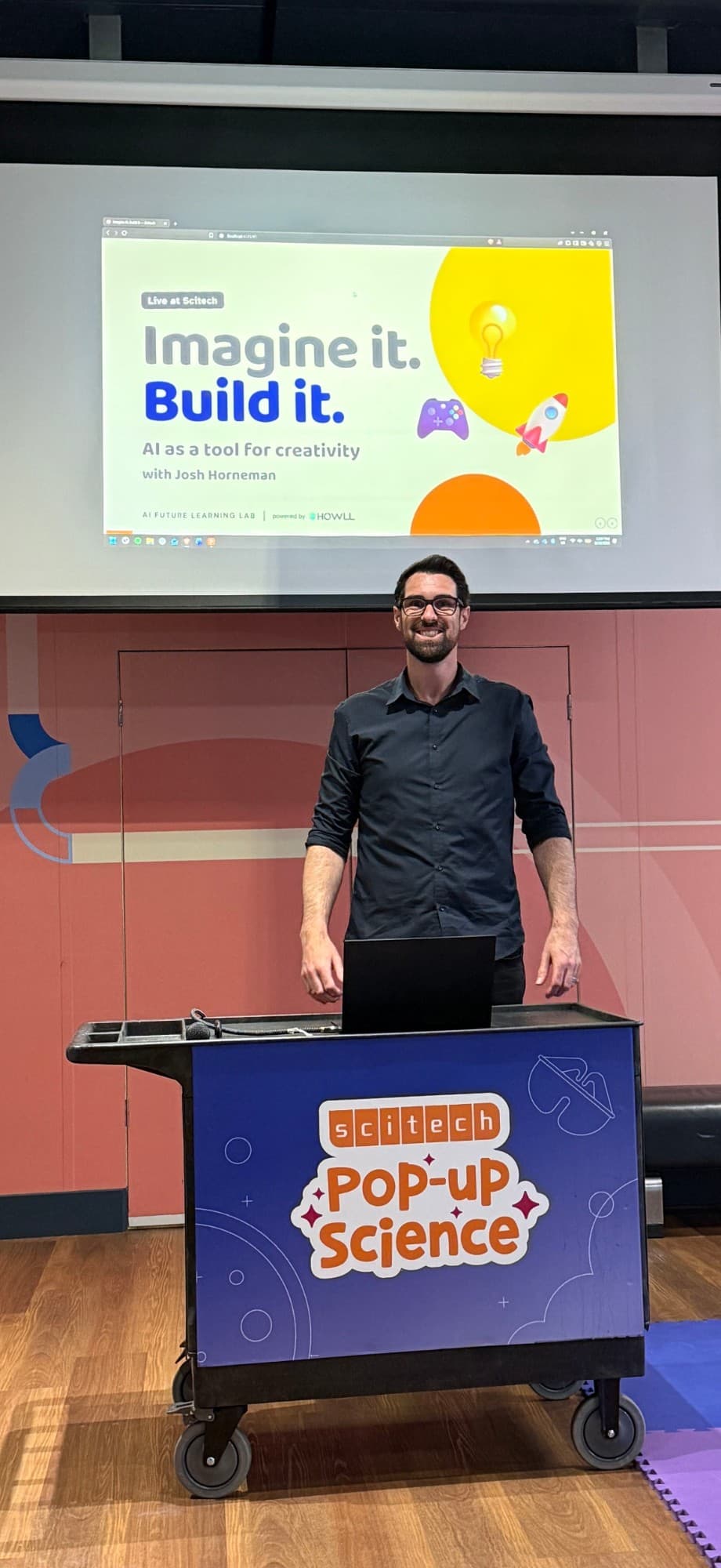
// In education
AI Future Learning Lab
The same idea applies to young people: AI as a tool for creativity, in the hands of someone curious. Through AI Future Learning Lab, which I co-founded, I run hands-on AI sessions for schools, educators and families.
Most recently that was “Imagine it. Build it.”, a workshop at Scitech on AI as a tool for creativity. Schools are now asking for the same.